

Smithfield General Market: From threatened demolition to new home for the Museum of London
As the Museum of London prepares to open its new home in Smithfield’s historic General Market later this year, Burrell Foley Fischer (BFF) and SAVE Britain’s Heritage have been reflecting on the campaign, more than a decade ago, that helped save the remarkable buildings from demolition. The opening will mark an important new chapter in the history of Smithfield; one that would have looked very different had the short-sighted developer’s brief for the ‘scooping out’ and 90% demolition of the historic buildings been approved.
In 2012, BFF was commissioned by SAVE Britain’s Heritage to develop an alternative vision for the General Market and Annex, at a time when proposals were being advanced to demolish much of the historic complex and replace it with a major new office development. This would have resulted in most of the formerly freely accessible public spaces being privatised and managed.
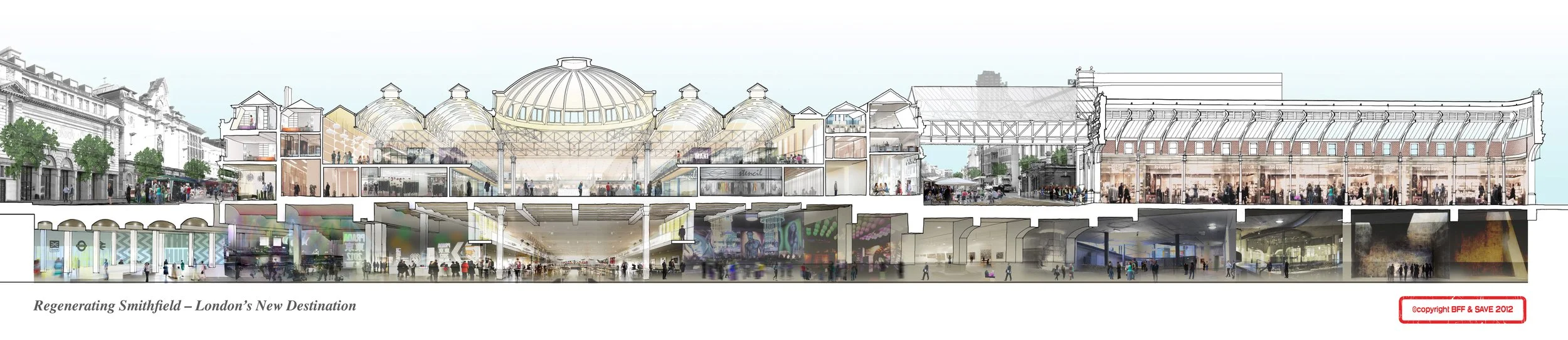
In the spirit of SAVE’s principles, rather than simply opposing the proposals, BFF set out to demonstrate that the buildings could have a viable future through sensitive adaptation and reuse. The resulting publication, Smithfield Market: The New Vision, presented a conservation-led alternative that retained the historic buildings while introducing a wide range of new uses and activity.
A different vision for Smithfield
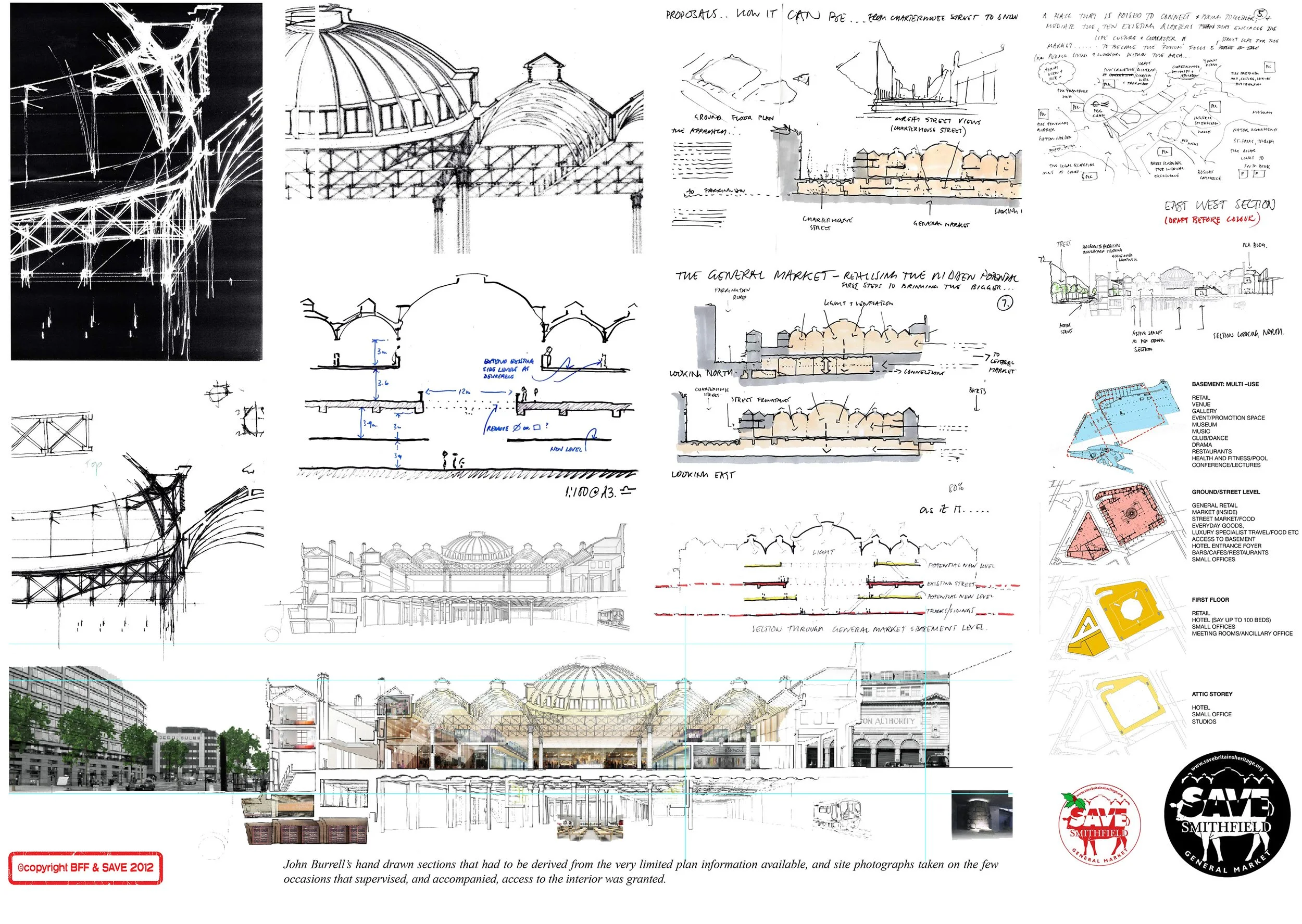
The work, led by BFF Founding Partner John Burrell, challenged the idea that the historic market buildings were an obstacle to the future development of Smithfield. A key part of BFF’s approach was to recognise that the significance of the General Market lay in much more than its external façades. The spectacular market hall, its roof structure, unique Phoenix columns and spatial relationship with the surrounding buildings were all integral to its character.
The alternative proposals therefore sought to retain the buildings and their interiors, rather than adopting a façade-retention approach. Utilising BFF’s extensive experience of designing for public use, they explored opportunities for new retail, cultural and exhibition uses. A significant breakthrough was the investigation and utilisation of the vast areas of basements and sub-basements that had been omitted from, and were not shown in, the developer’s proposals.
The proposals were developed in collaboration with SAVE and were intended to demonstrate that conservation could be commercially viable as well as architecturally and historically appropriate. Drawing on experience from successful market regeneration projects elsewhere, the vision showed how the buildings could once again become a lively destination, with new uses supporting their long-term future.
From alternative vision to public inquiry
The proposals became an important part of SAVE’s case during the subsequent public inquiry into the proposed redevelopment. John Burrell gave evidence on behalf of SAVE and the Victorian Society, presenting BFF’s alternative proposals and explaining the significance of the existing buildings and the opportunities for their conservation and reuse.
His evidence also explored the unique presence of the active underground railway tracks, which once extended beneath much of the basement as cattle were brought into the market above. BFF’s proposals incorporated this remarkable surviving infrastructure into a new vision for an underground world within the ‘Smithfield Quarter’, drawing on examples from cities as diverse as Toronto and Moscow.
The inquiry examined the architectural and historic significance of the General Market, Annex and associated buildings, including their remarkable interiors and roof structures. The Inspector concluded that the proposed redevelopment would cause substantial harm to the historic buildings and to the Smithfield Conservation Area.
The condition of the buildings was also considered. The Inspector found that they had suffered from deliberate neglect and concluded that their deteriorated condition should not be used to justify their demolition. The alternative proposals demonstrated that there was another option; rather than regarding the historic buildings as an impediment to development, they could form the foundation for a viable and distinctive future for the site.
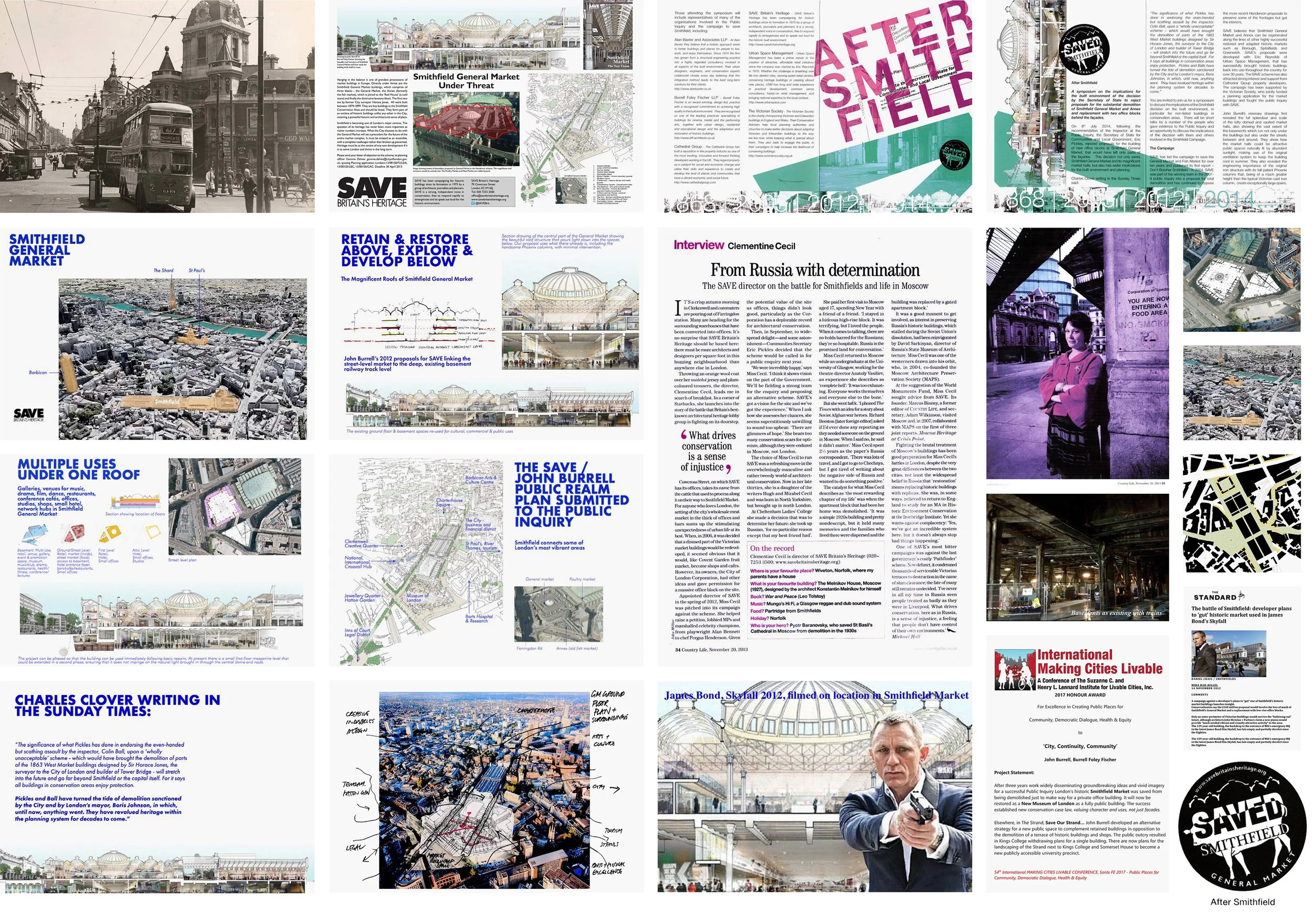
In July 2014, the Secretary of State rejected the proposed redevelopment, agreeing with the Inspector that it would cause substantial harm to the historic buildings and their setting. For SAVE, this represented a major victory after years of campaigning and the tireless and brilliant work of Director Clem Cecil to keep alive the case for Smithfield’s historic market buildings.
In its subsequent account of the campaign, SAVE described BFF’s work as “undoubtedly crucial to our success at the inquiry at which John Burrell was a witness.”
A new chapter for Smithfield
More than a decade later, the significance of that decision is particularly clear. The General Market is now being given a new purpose as the home of the Museum of London. The opening later this year will bring new audiences into the historic market buildings and give them a new role at the heart of Smithfield.
For BFF, the story illustrates the value of a conservation-led approach that looks beyond simply protecting historic fabric. The work at Smithfield demonstrated how understanding the significance of a place can inform a positive vision for its future and how design can help prove that conservation and change are not opposing forces.
As the Museum of London prepares to open its doors, the General Market is therefore entering a new chapter; one in which the buildings that were once threatened with demolition will instead continue to play an important role in the life of London.
The story remains a powerful example of what can be achieved when the architectural, historic and commercial potential of existing buildings is understood and championed with vision, insight and perseverance; working to an informed brief, and with a patron such as SAVE, to demonstrate a viable alternative future that ensures human-scale continuity in the life of the city.