

A paper by BFF Managing and Heritage Director Faye Davies on the restoration and adaptive reuse of Great Yarmouth’s Winter Gardens has been published in the Proceedings of the International Conference on Adaptive Reuse, Volume 1 (STH Press, 2026). The paper was first presented at the conference, hosted by the University of Pisa, Italy, in September 2025.
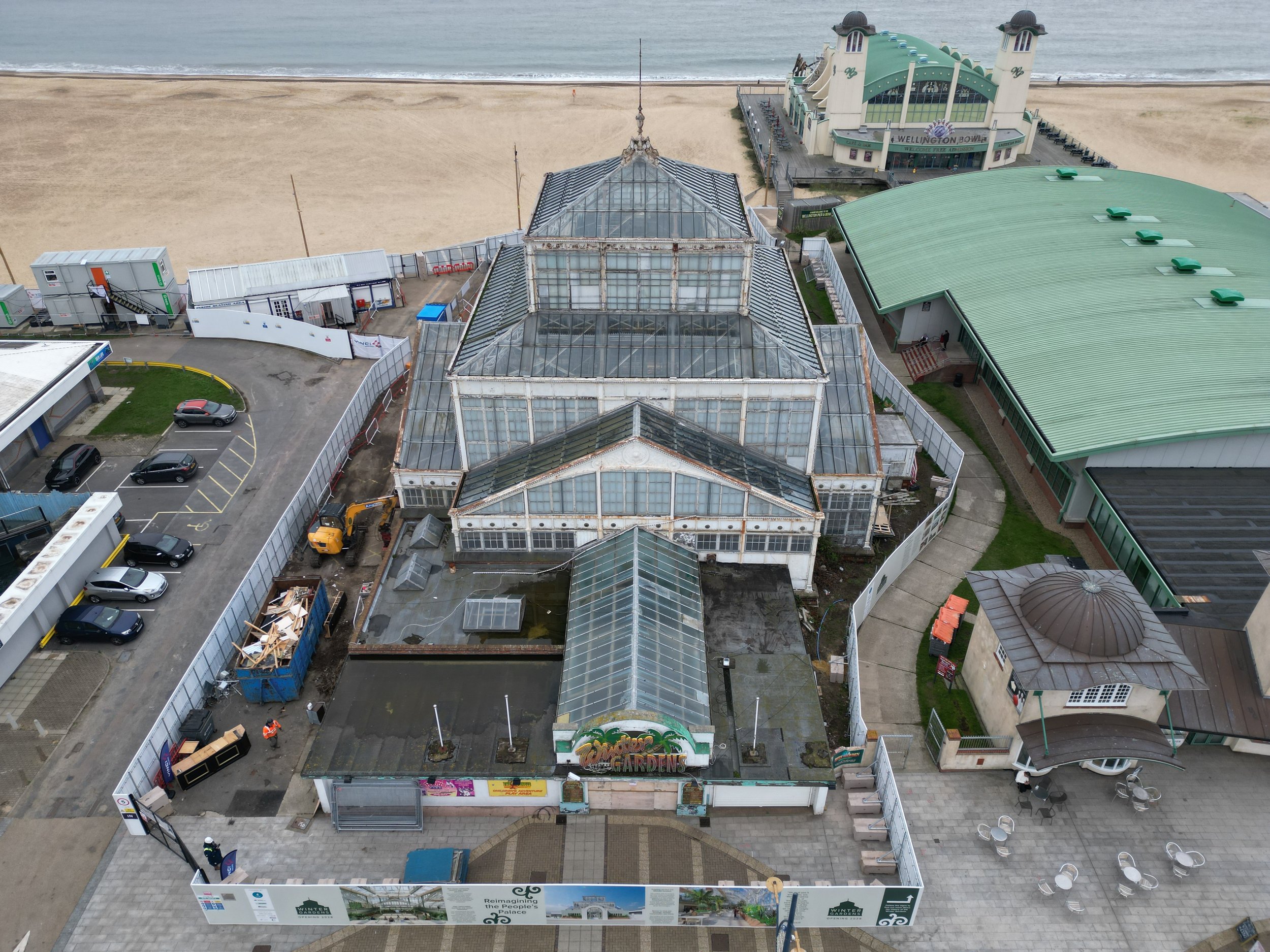
Titled Reclaiming the People’s Palace: Critical Conservation of Great Yarmouth’s Winter Gardens, it examines the challenges and opportunities of conserving and transforming this Grade II* listed building, the last surviving Victorian glass and cast-iron winter gardens on a British seaside promenade.
Drawing on BFF’s work to restore the building, Faye explores how a sensitive approach to conservation can reconcile the preservation of historic fabric with contemporary requirements for sustainability, accessibility and viable long-term use. She also considers the wider role of heritage-led regeneration in supporting economic revitalisation, community engagement and climate resilience.
Abstract
The adaptive reuse of the Grade II* listed Winter Gardens in Great Yarmouth, England, represents a landmark case in reconciling architectural conservation with socio-economic regeneration.
As the last surviving Victorian glass and cast-iron winter gardens on a British seaside promenade, the structure holds exceptional historical, aesthetic, and communal value. Once a beacon of leisure and horticultural wonder, the building suffered decades of neglect and is now on Historic England’s Heritage at Risk Register.
Sustainability is central to the design approach, recognising that robust service systems are essential for operational efficiency and for futureproofing in a changing climate. This paper examines the ambitious restoration led by Burrell Foley Fischer Architects, which navigates the delicate interplay between historical preservation and modern requirements.
Key to the project is the reinstatement of original features, including arched timber screens, and the meticulous repair of its ornate cast and wrought ironwork. Simultaneously, contemporary sustainability measures such as natural ventilation systems, air source heat pumps, and low-carbon glazing have been discreetly integrated to meet present-day environmental standards without compromising heritage significance.
The project is deeply embedded in the socio-economic context of Great Yarmouth, one of the UK’s most deprived coastal communities. It demonstrates how heritage conservation acts as a catalyst for wider urban transformation, driving economic revitalisation, public engagement, and climate resilience.
Through a critical conservation lens, the paper explores strategies that balanced authenticity with adaptation, and the collaborative processes involving heritage bodies, engineers, and the local community.
Ultimately, the Winter Gardens exemplifies how adaptive reuse can transform underused historic sites into vibrant civic spaces, safeguarding layered histories while addressing contemporary needs. It is a model for heritage-led regeneration; where conservation does not retreat into the past, but creatively shapes sustainable, inclusive futures.
The published paper is available to read and download from STH Press.