

This Saturday, the doors open on the new London Museum at Smithfield General Market. After ten years of work, the long-derelict Victorian market buildings are one of the capital's most talked-about new destinations. Little more than a decade ago, they faced 90% demolition. Smithfield was nearly lost.
In 2012, BFF worked with SAVE Britain's Heritage to develop an alternative to a developer's scheme that would have gutted the General Market and Annex and replaced them with a major office development. Led by Founding Partner John Burrell, our study, Smithfield Market: The New Vision, set out a conservation-led alternative that retained the buildings and their interiors, not just their façades. It proposed new retail, cultural and exhibition uses, and made use of the vast basements and sub-basements that the developer's proposals had overlooked.
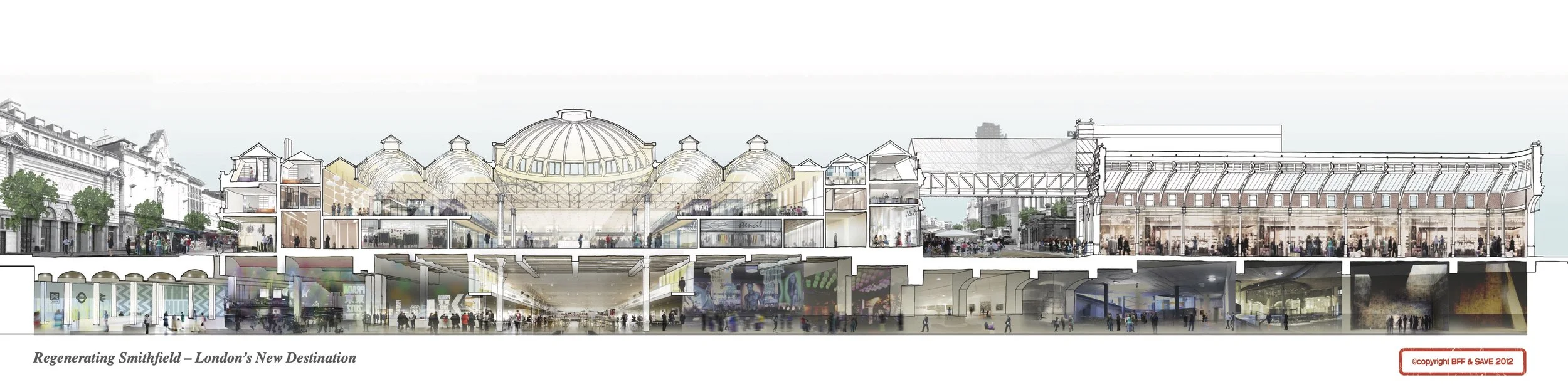
The proposals formed a key part of SAVE's case at the public inquiry, where John gave evidence on behalf of SAVE and the Victorian Society. The Inspector concluded that the redevelopment would cause substantial harm and that the buildings' neglected condition could not justify their demolition. In July 2014, the Secretary of State rejected the scheme. SAVE later described BFF's work as "undoubtedly crucial to our success at the inquiry."
Today, the market hall, with its roof structure and Phoenix columns, is the star of the museum. We congratulate the London Museum team on the restoration, and our friends at SAVE, whose determination kept the case for Smithfield alive.
Reviewing the opening in the Guardian, Oliver Wainwright calls it "best possible proof" that the warnings of SAVE and its allies should be heeded, and that "the most sustainable, viable, life-affirming buildings are the ones that already exist, brimming with layers of history and cultural memory." https://www.theguardian.com/artanddesign/2026/nov/24/fatberg-museum-of-london-astonishing-smithfields-architecture
Smithfield is a clear example of the philosophy that underpins our work at BFF. Understanding what makes a building significant shows how it can change, and conservation and change are not opposing forces.
Read our earlier reflection on the campaign.